
Why Accuracy Matters When We Talk About Rape
A survivor's thoughts on the CNN "Online Rape Academy" article

Content warning: This post discusses rape, drugging, sexual abuse by intimate partners, and online spaces where sexual violence is normalized and shared. Please take care of yourself.
I’m a survivor of multiple rapes, all of which were by people I knew. Two of them happened while I was intoxicated. I’m also a certified rape crisis counselor and a former victim advocate in the Philadelphia District Attorney’s Office. I was the Sexual and Relationship Violence Prevention Coordinator at West Chester University in grad school. I’ve given hundreds of sexual violence prevention presentations at schools and universities across the US.
So when I say this CNN investigation made me sick to my stomach, I’m not saying that from a safe distance. I know how real sexual violence is. I know how often it gets minimized, misunderstood, or dismissed entirely. I also know that once a story like this starts ricocheting across the internet, precision matters.
In March, CNN reported that a porn site called Motherless.com hosts more than 20,000 videos of so-called “sleep” content, much of it tagged in ways that strongly suggest unconsciousness, sedation, or both. The article also describes comment sections on these videos that link to chat spaces, including a now-defunct Telegram group called “Zzz” with roughly 1,000 members. According to CNN, men in that group shared advice about drugging their partners, talked about dosing, sold substances they claimed would render women unconscious, and in some cases advertised paid livestreams of abuse.
CNN also quoted Sandrine Josso, a French lawmaker who has campaigned to raise awareness about drug-facilitated sexual abuse after she says she was drugged by a former French senator.
She called the groups “schools of violence.”
“I would even call them an online rape academy, where every subject is taught. There are all the ‘subjects’ and ‘disciplines’ needed to become a good rapist or sexual predator,” she said.
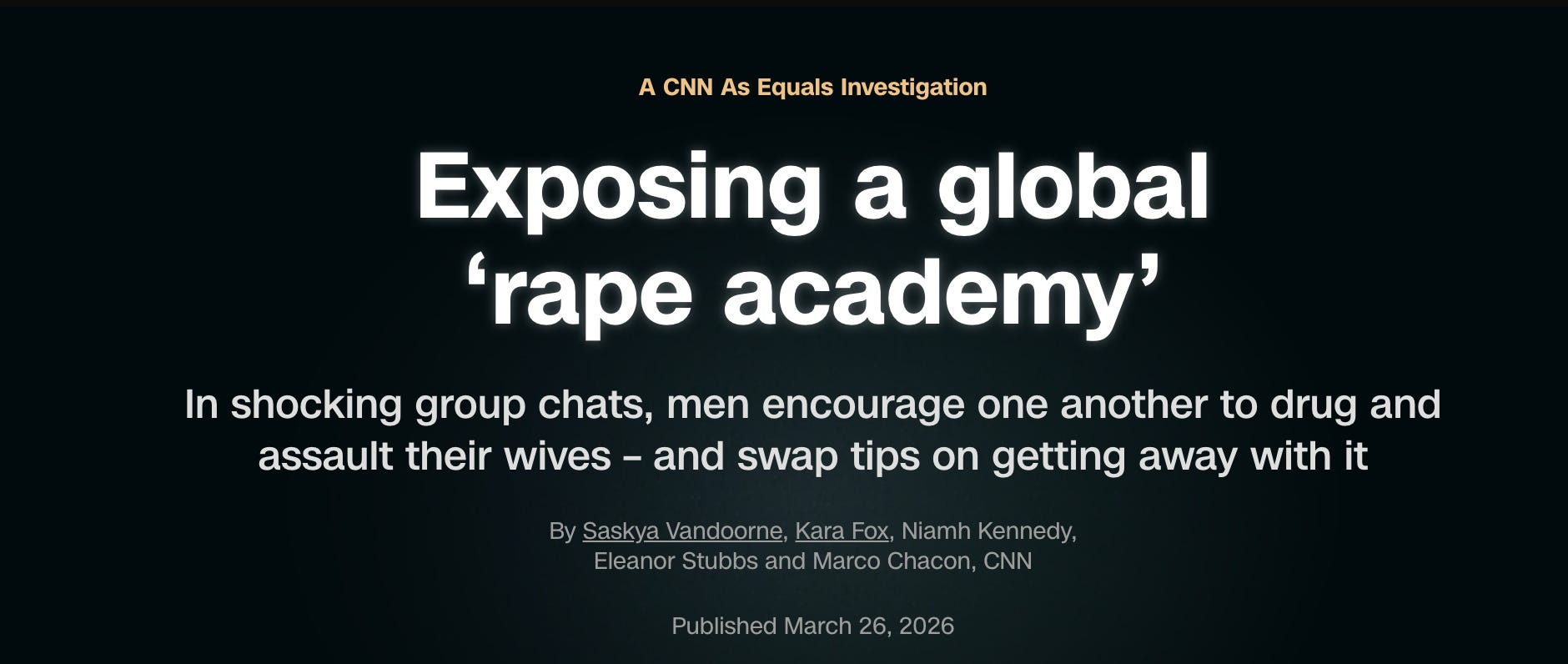
That’s where the “rape academy” CNN headline came from.
That phrase came from a source in the article. The article also notes that in February 2026, Motherless.com had 62 million visits to the website. This was not evidence that 62 million men were enrolled in, visiting, or actively participating in a single organized training space.
CNN was irresponsible in the way it framed this story. The reporting pulled together several serious but separate threads: Motherless.com hosting “sleep sex” videos, with no clarity around how many of which were filmed non-consensually; user-generated comments on those videos pointing people toward off-platform spaces; a Telegram group of roughly 1,000 men allegedly sharing tactics for drugging and violating partners; the Gisèle Pelicot case; and the accounts of real survivors harmed by people they trusted.
Each of those issues matters. Each one deserves attention. But the headline and framing blurred them together in a way that made panic, distortion, and viral misinformation much more likely. That is not a small editorial failure. When a news organization takes an already horrific story and packages it in the most inflammatory possible way, it does damage twice: first by muddying the facts, then by making the resulting backlash easier to dismiss. Survivors of sexual violence do not need sensationalism. They need accuracy, seriousness, and reporting that can withstand scrutiny.
What stands out to me, from an impact and advocacy perspective, is what happens after a story like this hits social media. People get activated, disgusted, furious, terrified, and the version that spreads fastest is usually the one that hits the nervous system hardest. That is how exaggeration takes over. It is also why media literacy matters. If we care about this issue, we need to care about what the article actually says, because the truth is already horrific. “62 million men visited an online rape academy in one month” is not what the article says, and it is not what the headline says either.
CNN published this investigation on March 26. The large social media backlash seems to have picked up in mid-April, and much of it centered on the same misquoted statistic being repeated from post to post. Snopes has now published a fact check debunking that claim. That matters because the second the facts get distorted, people looking for a reason to dismiss the story get one. They do not have to grapple with the abuse CNN actually documented. They get to point to the inaccurate version, say “Snopes debunked that,” and move on as if the entire underlying story falls apart with it. Then the conversation shifts from sexual violence to whether a viral claim was overstated, and the real harm slips out of focus.
There is another cost to this exaggeration. For survivors scrolling social media, it can make an already horrifying story feel even bigger, murkier, and more impossible to process. To be clear, any number more than zero is WAY TOO FUCKING MANY. The truth is already enough to crack you open. We do not need to turn it into something even more sprawling and shapeless in order to take it seriously. It’s fucking serious.
If you are reading this and feeling sick, enraged, or helpless, that makes sense. The question is what to do with that feeling besides feeding it back into the algorithm.
You can support the people already doing survivor-centered work. Donate to national rape crisis organizations or, even better, your local rape crisis center. Volunteer if you have the capacity for crisis line work, hospital accompaniment, prevention education, or advocacy. Pay attention to laws around non-consensual intimate media, drug-facilitated sexual assault, and platform accountability. Call your representatives. Write the email. Sign the petition. Support the impactful work, not just the public outrage.
And if social media starts to feel like a trauma swamp, step away. You do not have to absorb every detail of a horrible story to prove you care. Reading hundreds of comments will not make you wiser. Fighting with strangers whose brains are running on adrenaline and fury will not help survivors. Mute what you need to mute. Close the app. Text someone who cares about you. Eat something. Go outside. Let your body move through the stress response cycle.
For the men witnessing this, believe survivors. Do not use factual corrections as an excuse to minimize the harm. Call out your friends, colleagues, and strangers when they do problematic shit. Step up.
The facts published in this article are horrific. They are already enough to justify outrage, grief, and action. We need to stay clear about what is factually accurate, because that is how people get supported, how policy gets sharper, and how calls for accountability get directed where they belong. We also need to hold media companies to a high standard when they publish reports of this nature. There is no room for sensationalized, sloppy framing around subjects that are already this highly charged.
For further context, there was a fantastic podcast episode on ICYMI with Kate Lindsay that explains the facts thoroughly.
Here’s a really nuanced conversation between Taylor Lorenz and Kat Tenbarge about the misinformation that went viral and its impact. (There are plenty of valid critiques of Taylor in the world but this episode was solid).
Resources:
RAINN.org (Rape Abuse Incest National Network) which has free anonymous hotlines and peer support text chats for survivors
NSVRC.org (National Sexual Violence Resource Center) which has lots of free resources for survivors, friends, and advocates
For porn literacy and ethical consumption, Ethical Porn for Dicks was written by sex therapist and research Dr. David Ley
SWOPLA (Sex Workers Outreach Project) which has resources and advocacy for consensual sex workers and adult performers